Ohitorisama Economy: Why Asia's Best Cities Built a Whole Dining Scene Around Eating Alone
From Ichiran's partitioned booths to Seoul's honbap counters and Taipei's noodle bars, Asia's biggest cities have quietly built restaurants designed around eating alone — and some do it far better than others.
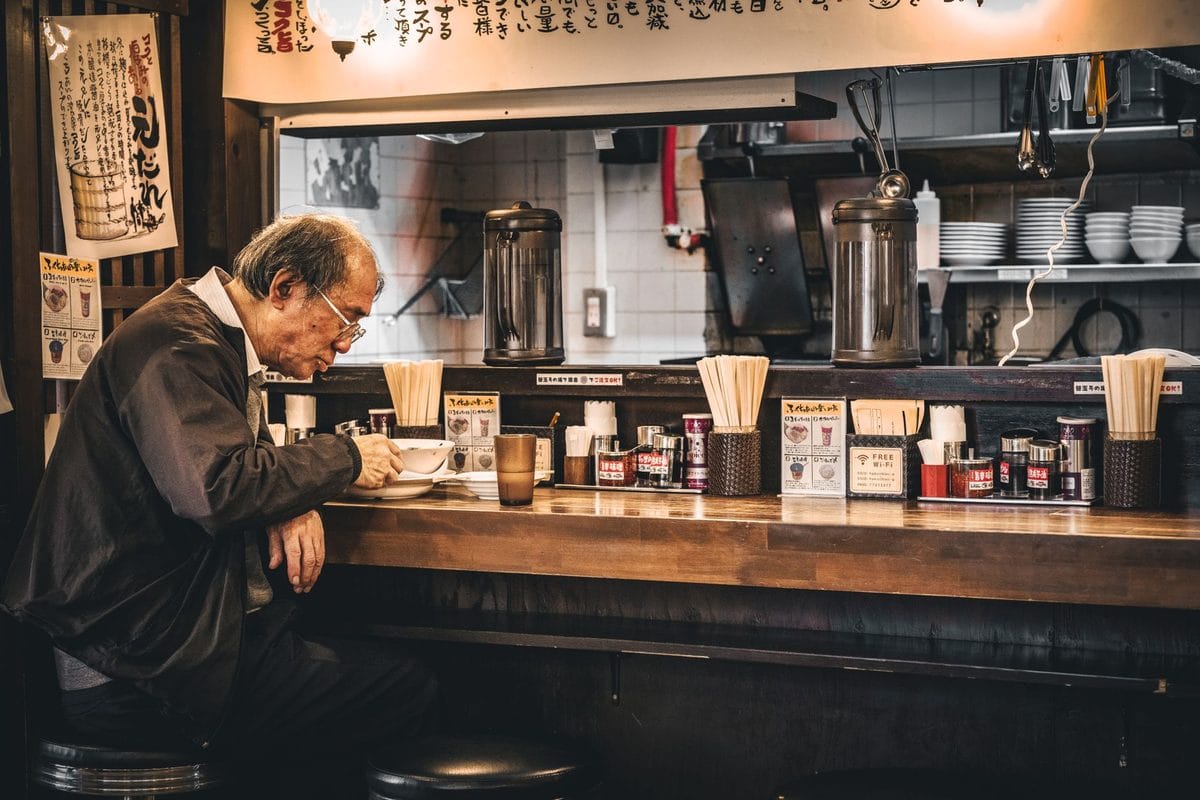
The first time I sat down at Ichiran in Shibuya, I thought I'd wandered into a library. Wooden partitions rose on three sides of my seat, blocking the diners next to me from view, with a single order form and a call bell where a waiter would normally hover. Nobody made eye contact. Nobody needed to. A staff member's hands appeared through a small curtain to place down a bowl of tonkotsu ramen, and that was the entire transaction. It cost me 980 yen, took eleven minutes from order to empty bowl, and it remains one of the most quietly perfect meals I've had in this city.
A seat built for one, and nobody apologizing for it
Ichiran didn't invent solo dining, obviously. People have eaten alone at counters for as long as counters have existed. What the chain did, starting in Fukuoka decades ago and now running dozens of branches across Tokyo, Osaka, and beyond, was formalize the solo seat as its own category of hospitality rather than an awkward leftover of a table built for four. The booth isn't a punishment for not bringing friends. It's a design decision that assumes you might actually prefer it that way, and once you've eaten a bowl of ramen with zero small talk and zero waiting for anyone else to finish their food, it's hard to argue the assumption is wrong.
Japan has a term for this: ohitorisama, roughly "the party of one," and it carries none of the pity that the English phrase "table for one" tends to imply. What started as a description of women dining alone without apology in the 2000s has widened into a full consumer category — solo karaoke booths, solo yakiniku grills with a single hotplate sunk into a bar counter, solo hot pot restaurants where a divided pot means nobody has to negotiate broth flavors. The infrastructure exists because the demand was there first, not the other way around, and any restaurant owner in Tokyo will tell you that a solo diner who eats there twice a week is worth more over a year than a group that shows up once a month for a birthday.
The Ichiran model and what it actually protects
What the booth partitions really protect isn't privacy from strangers — it's the diner's own pacing. You eat as fast or as slow as you want, refill your water without flagging anyone down, and leave the second the bowl's empty. That's the entire pitch, and it works precisely because Tokyo's lunch break is short and its evenings are long, so a seat that lets you control your own tempo is worth paying for.
Seoul's honbap generation turned eating alone into an identity, not a fallback
Korea took a different route to the same destination. The word is honbap — literally "alone rice" — and it emerged out of necessity in the mid-2010s as more young Koreans lived by themselves, worked long hours, and simply stopped waiting for company to justify a meal out. Restaurants in Euljiro and Yeonnam-dong responded by shrinking the minimum order. Samgyeopsal joints that used to require a two-person minimum grill order now sell single-portion sets for around 15,000 won, roughly eleven US dollars, cooked on a small personal grill instead of the shared plate built for a group. Convenience store chains like GS25 and CU built entire aisles around it too, with ready meals sized and priced for one person eating standing at an in-store counter rather than at a table at all.
I'll say this plainly: Seoul does solo dining better than Tokyo does, at least for anyone on a real budget. Ichiran's booths are elegant, but you're still paying ramen-shop prices for a bowl of noodles. In Euljiro you can get a full solo barbecue set, rice, banchan, and a bottle of soju for under fifteen dollars, sitting at a counter that was clearly designed with a single diner's elbow room in mind rather than retrofitted from a four-top. That's not a minor difference — it's the gap between infrastructure built for solo diners from day one and infrastructure that's merely tolerant of them.
Taipei runs the same idea through counters that never needed reinventing
Taipei's version looks less deliberate because in a sense it always existed. Beef noodle shops along Yongkang Street have had bar seating since before “ohitorisama” was a marketing term anywhere, because a bowl of niu rou mian, at roughly 200 to 250 Taiwan dollars, around seven US dollars, was always a fast solo meal eaten standing or perched on a stool between errands. What's changed is the tier above it. Din Tai Fung's counter seats, once an afterthought near the kitchen, now get requested specifically by solo diners who want to watch the xiaolongbao folding station instead of staring at an empty seat across the table. A few izakaya-style spots in Zhongshan have gone further, adding single-seat tasting menus around 1,200 Taiwan dollars, roughly 38 US dollars, explicitly marketed at professionals eating on their own after work rather than at couples or groups.
The catch nobody mentions when they praise this trend
Here's the part travel writers usually skip.
Solo-dining infrastructure only works this well in dense cities where rents allow a restaurant to profit from a counter seat that turns over every twenty minutes. Try to find the same booth-and-bell efficiency in a mid-sized Chinese second-tier city or a Southeast Asian suburb and you'll mostly find the opposite: tables built for groups, minimum spends per table rather than per head, and servers who visibly recalibrate when a party of one walks in. The ohitorisama economy is a Tokyo-Seoul-Taipei phenomenon first, and it travels unevenly. Even within Tokyo, high-end omakase counters remain the exception — a solo diner at a twelve-seat sushi bar charging 25,000 yen a head is still rarer than the marketing suggests, mostly because reservations for those seats get snapped up by groups first. And in cities like Manila or Jakarta, where a lot of dining still happens over shared plates by default, a solo diner asking for a single-portion set can still get a puzzled look from the server rather than a laminated one-person menu.
Where I'd actually send you, and where I wouldn't bother
Skip the solo-dining novelty restaurants that lean hard on the gimmick — the ones with partition walls so tall you can't see the room at all feel more like a sensory deprivation booth than a meal. Go instead to a place that simply built a good counter and let you use it: Ichiran for the ramen you already know is reliable, a Euljiro samgyeopsal counter for genuinely better value than anything in Tokyo at that price point, and a Yongkang Street noodle stool in Taipei if you want proof that solo-friendly dining was never actually an innovation, just a habit some cities happened to keep.
What I wouldn't do is treat any of this as a curiosity to photograph once and move on from. The point of a good solo counter isn't the novelty of eating without company — it's that the seat, the pacing, and the price were all built around one person's actual evening, not a group's. Once you've had that a few times, going back to a table built for four and eaten alone with an apologetic waiter hovering nearby feels like the real downgrade.