Who Calls the Day Off? How Hong Kong, Taipei and Tokyo Each Stop a City for a Typhoon
Hong Kong runs on numbered signals, Taipei leaves the call to a mayor, and Tokyo's railways decide for everyone. Here is how each city stops for a typhoon, and what to do if one arrives this October.
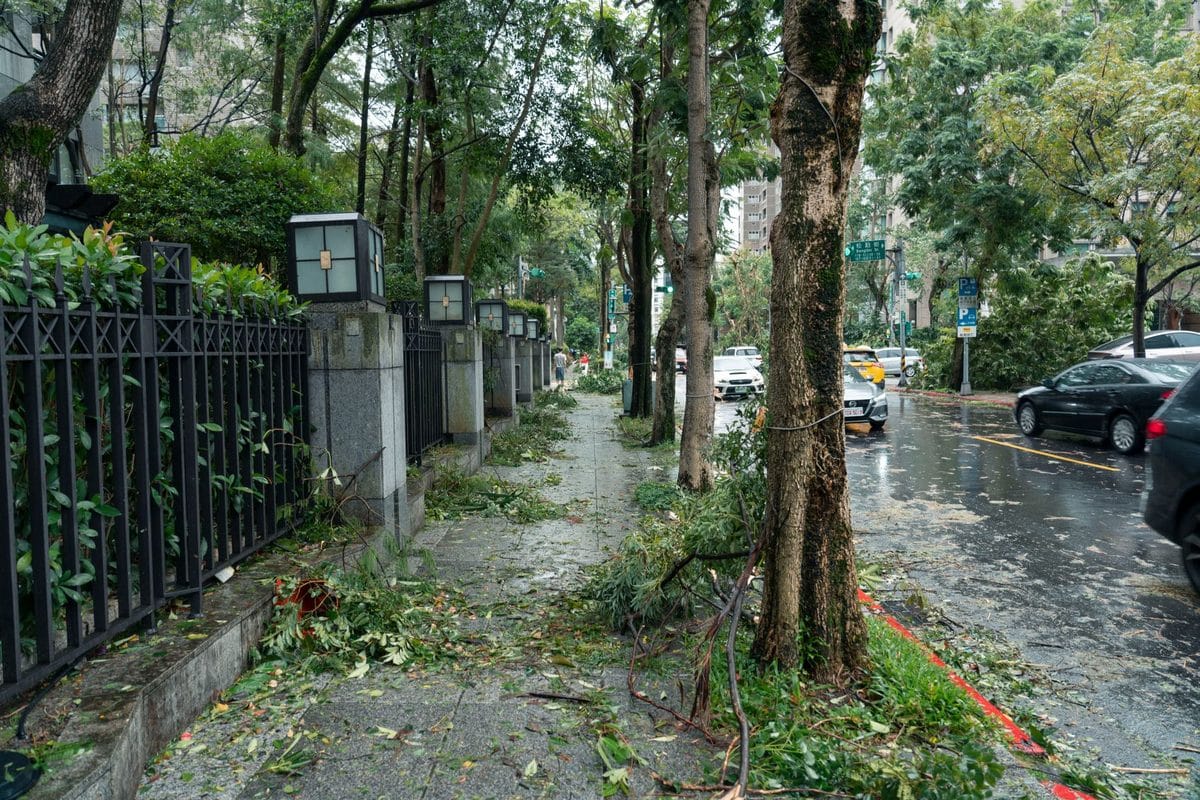
Twice in 2025 the Hong Kong Observatory hoisted its Hurricane Signal No. 10, the top rung of its warning ladder: for Typhoon Wipha on 20 July and again for Super Typhoon Ragasa on 24 September. Only one earlier year, 1964, had produced two. By the Observatory's own count, 14 tropical cyclones forced it to raise some kind of signal over the year, against a long-term average of about six, and Ragasa alone left at least 5,062 reports of fallen trees and more than 700 cancelled flights at the airport. The season does not end when the heat does, either. Typhoon Koinu kept Hong Kong under Signal 8 over the night of 8 to 9 October 2023, and Typhoon Hagibis made landfall in Japan on 12 October 2019.
What matters more than the wind speed, if you live in or visit these cities, is who decides that everyone goes home. Hong Kong hands that decision to a numbered signal, Taiwan hands it to a mayor, and Tokyo, in practice, hands it to the railways. Each answer comes with its own rhythm for the day, its own deadlines and its own ways of going wrong.
Hong Kong: a ladder with a rule on every rung
Hong Kong's system is the most mechanical of the three. The Observatory ranks storms on a ladder of signals (1, 3, 8, 9 and 10), and almost everything else, from school closures to bus timetables, hangs off a particular rung. Signal 3 changes little for an adult commuter, and the MTR and buses carry on as normal. Signal 8 changes everything: the Observatory makes a special announcement within two hours before hoisting it, most offices and businesses close, school classes and most government services stop, and people without a reason to be out are expected to be indoors. According to Hong Kong Free Press's explainer, most bus routes wind down within about two hours of the hoist.
The MTR is deliberately the last thing to stop. Under Signal 8 its trains and Light Rail initially run normally, with extra frequency if needed so people can get home, then drop to a limited service as the storm closes in, while MTR's own buses are suspended three hours after the hoist. At Signal 9 or 10 the open-air sections of the railway and Light Rail stop immediately, the underground sections keep a thinner service going, and stations stay open where possible as shelter. The operator is blunt about the catch: if conditions deteriorate suddenly, services can be suspended at once and without notice. The gap between "the signal is up" and "the trains are still running" is a courtesy, not a guarantee.
Work is where the rules get interesting. The Labour Department's Code of Practice is guidance rather than statute, although it spells out employers' legal duties under laws such as the Employment Ordinance. Its central instruction is that employers and staff agree in advance when people leave as Signal 8 approaches and when they come back once it drops. One example it gives is returning within two hours, as far as possible, if the signal is cancelled during working hours, with employers exempting staff from returning at all if it comes down close to the end of the day. For the worst cases there is also an "extreme conditions" announcement, which the government can make after a super typhoon leaves large-scale power cuts, windows falling from high-rises, major landslides or widespread transport paralysis, and the Code treats it like a Signal 8 for work purposes.
Taipei: the forecast comes from an agency, the decision from a politician
In Taiwan the Central Weather Administration forecasts the storm, and a mayor or county magistrate decides whether anyone goes to work.
The legal framework is the Executive Yuan's regulations on suspending offices and classes during natural disasters, and its wind test is specific: a forecast that the storm's radius will pass over an area within four hours with sustained winds of force 7 or gusts of force 10. Rainfall has its own reference levels, and an area can also qualify when transport or utilities are cut even if the weather misses the numbers. None of this is an automatic switch. The head of each municipality, county or city weighs the forecast against traffic, power, water and actual risk, then announces, and the rules push that toward a predictable rhythm: between 7 and 10 p.m. the evening before, with broadcasters asked to carry it by 11 p.m. If the weather turns after midnight, the cut-off for a morning suspension is 4:30 a.m. The Directorate-General of Personnel Administration keeps a live list for every city and county, and that is the page to check rather than a forwarded screenshot.
For employees, the regulation itself covers government agencies and schools. Private firms fall under a Ministry of Labor guideline, which says an employer may not mark you absent, withhold a full-attendance bonus or hold back pay when the head of the area where you work, where you live, or the only route between the two announces a suspension. That wording, counting your home city as well as your workplace's, tells you neighbouring places can and do answer differently.
Because a person makes the call, people argue about it. In July 2026 some municipalities cancelled school and work on a Friday after Typhoon Bavi even though they had seen no significant wind or rain, and critics worried that typhoon days could become routine. The Executive Yuan replied on 16 July that the current standards are already clear and objective and that it has no immediate plans to amend them, adding that local governments coordinate within shared living zones and are expected to use their discretion in line with those standards. The upside of the arrangement is a single yes-or-no before bedtime. The cost is that the yes-or-no is still a political judgement, whatever the wind-speed table says.
Tokyo: the timetable makes the call
Japan has the quietest version of the three. The announcement that actually reshapes a Tokyo day comes from the railways, which publish a planned suspension, known as keikaku unkyū (計画運休), ahead of the worst weather. The transport ministry had set a guideline in July 2019 saying it is desirable to announce the possibility of a suspension 48 hours ahead and a detailed plan 24 hours ahead. Two months later Typhoon Faxai showed what a thin warning costs: JR East announced on 8 September that early-morning services the next day would be suspended until 8 a.m., but restarting the lines dragged on past that time, would-be commuters rushed into stations, and stations and trains could not hold the crowds. By the Japan Times's account, the journeys of about 2.7 million people were affected.
Hagibis, a month later, got the full treatment. On Thursday 10 October, JR East and private operators warned that lines including the Yamanote, Chuo and Tokaido could stop on Saturday and Sunday, and JR East promised line-by-line times by 10:30 a.m. the next day, with information in English, Chinese and Korean. ANA cancelled every domestic flight in and out of Narita and Haneda for the Saturday. When the storm arrived, many bullet-train services were halted and several Tokyo metro lines were suspended for most of the day, more than 1,000 flights had been cancelled, and supermarkets had empty shelves after residents stocked up. The BBC reported that more than seven million people were urged to leave their homes, yet only about 50,000 are thought to have stayed in shelters.
The easiest system to plan around is Tokyo's, because it speaks first and early. What happens at your desk once the trains stop is still left to your employer.
What to do if you are in one of them this month
Early October is still inside the season, so have the drill ready before the forecast turns.
- Hong Kong: treat the Observatory's special announcement before Signal 8 as your cue to leave, not the hoist itself, and secure loose objects such as flower pots and drying racks as soon as Signal 3 goes up. The Observatory's own checklist says to finish every precaution before gales begin.
- Taipei: check the personnel administration's list from about 7 p.m. the evening before, since the announcement is due by 10 p.m.
- Tokyo: act on the first notice of a possible suspension, not the detailed schedule a day later.
- Everywhere: a torch, spare batteries of the right type, water and food for a couple of days. Faxai's power cuts hit as many as 935,000 households around Tokyo, and the experts quoted by the Mainichi told readers to check battery sizes before the storm, not during it, among other basics.
Japanese guidance is the most concrete. Experts quoted by the Mainichi advised closing curtains, putting shatterproof film or cardboard and tape across windows in X shapes, and moving to a room without windows, and they recommended wearing shoes indoors if a window does break. Japan's land and transport ministry suggests blocking drain outlets with water bags made from two plastic bags of 45 litres, half filled with water, because sewage can back up through bathroom and washing-machine drains even when the street outside is dry.
One rule needs no translation anywhere. Under Signal 10 the Observatory warns that if the eye of a storm passes directly overhead there may be a temporary lull, followed by a sudden return of violent winds. If the air goes still and the sky brightens in the middle of a typhoon, stay exactly where you are.