Sleep by the Hour: How Capsule Pods Became Asia's Backup Room
Once an emergency fix for salarymen who missed the last train, Asia's capsule hotels have become the region's on-demand reset room — booked by freelancers, gamers and business travelers who just need six quiet hours.
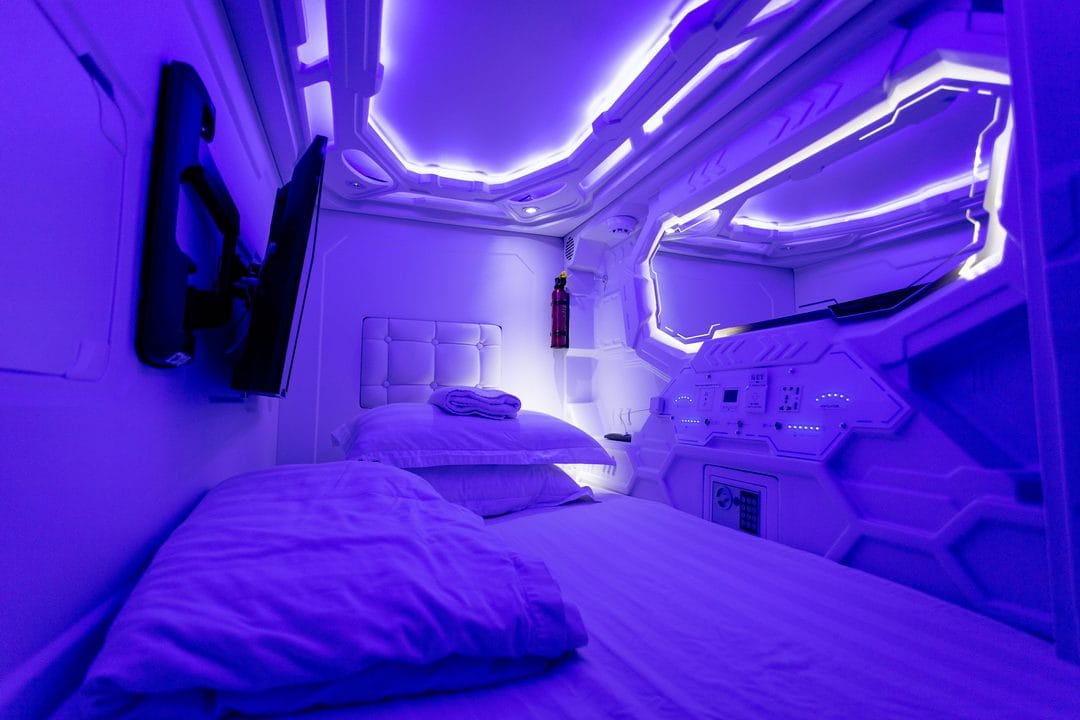
Half past midnight in Shinjuku, and the last Yamanote train pulls out three minutes before Daisuke reaches the platform. A decade ago, this meant an all-night izakaya, a bench in a twenty-four-hour manga cafe, or a taxi receipt nobody wanted to explain to a manager the next morning. Tonight he takes the elevator two floors above the ticket gates, taps his phone against a reader, and slides into a molded pod barely bigger than a single mattress. Six hours later he's back on the platform for the first train, showered, wearing a fresh shirt bought from the vending machine downstairs, having paid less than half of what a standard business hotel room would have cost for the same six hours. Nobody at the front desk asks why he's here alone at 1 a.m. — half the pods on this floor are already full of people doing exactly the same math he just did.
From Emergency Nap to Everyday Reset
The capsule hotel wasn't invented as an emergency measure — it was engineered as one, deliberately, by the architect Kisho Kurokawa, whose Capsule Inn Osaka opened near Umeda Station in 1979 with stacked fiberglass units barely large enough to sit up in. For close to three decades the format stayed a niche solution to a very specific problem: what a salaryman does when he's missed the last train home and doesn't want to spend forty dollars on a taxi across town. That single use case defined the whole industry's design language, right down to the shared bathrooms and the check-out-by-10-a.m. house rules. What's changed since roughly 2015 is who's walking through the door and why. Freelancers now book a four-hour daytime slot between client meetings just to lie flat and reset before an evening call. Long-haul travelers landing at Narita or Incheon after midnight book a pod instead of gambling on finding a taxi driver willing to make the airport run. And a growing slice of bookings come from people who already live in the same city — Tokyo residents whose apartment is being fumigated, Seoul office workers pulling back-to-back all-nighters before a product launch, guests who simply want six hours of total quiet that a shared apartment can't offer.
The Region's Capsule Map
Japan still runs the deepest bench. Nine Hours, the chain that popularized the minimalist white-pod aesthetic now copied across the region, operates locations built directly into or beside stations in Tokyo, Kyoto and Fukuoka, plus both major Narita and Haneda terminals, with a single overnight stay typically running under ¥6,000 — roughly a third of what a mid-range Tokyo business hotel charges for the same square footage. First Cabin takes the format upmarket, styling its pods as airline cabin classes, complete with wider berths sold as "first class" for guests who want the concept without feeling quite so much like cargo.
Hong Kong's version leans into the city's chronic space shortage in a different way. Mini Hotel, with locations in Central and Causeway Bay, compresses standard hotel service into rooms not much larger than the capsule format itself, marketed explicitly at guests who'll spend twelve hours a day outside the room anyway. It's worth being precise about the distinction, because coverage aimed at international readers tends to blur it: a capsule hotel is a commercial hospitality product a guest chooses and pays for by the night, while the city's infamous subdivided "cage homes" are a housing-affordability crisis that traps long-term residents who have no other option. Conflating the two flattens a real social problem into a quirky travel headline.
Singapore took the format upscale earlier than most. YOTEL's Orchard Road property built its entire brand around what it calls "cabins" rather than capsules, targeting business travelers who want a real desk and a rainfall shower in under 150 square feet, while The Pod, tucked into a converted shophouse near Beach Road, keeps the original backpacker spirit alive with curtained bunks instead of full enclosures for guests who don't need the privacy premium.
Taipei's Star Hostel chain, with its flagship near Taipei Main Station, applies the same logic to a younger, more budget-conscious crowd — travelers connecting between high-speed rail lines who need six hours of sleep, not a full room, before an early departure to Tainan or Kaohsiung.
Built for the Reset, Not Just the Redemption
The floor plans give away who the newer bookings are actually for. Several Tokyo properties now reserve entire floors as women-only, with separate keycard access and lounge areas that don't exist in the original 1979 blueprint. Others have added gaming pods wired with monitors and mechanical keyboards for streamers who want a change of scenery without hauling a rig across town, quiet pods marketed specifically as daytime nap slots billed by the hour rather than the night, and a handful of properties experimenting with sealed sleep capsules inside coworking floors — so a freelancer can book a desk in the morning and a pod for a 2 p.m. crash without changing buildings. None of these were part of the format's original pitch, and taken together they describe an industry that stopped selling emergency shelter and started selling scheduled recovery time, sold in blocks as short as ninety minutes at some Tokyo locations.
Where It Breaks Down
Capsule pods stopped being a joke about Japanese quirkiness roughly the same year they stopped being cheap.
Prices at flagship Nine Hours and YOTEL locations have crept close to what a compact hotel room costs in the same neighborhood, which undercuts the original value proposition for budget travelers even as it makes the format more attractive to business guests who'll expense it anyway. Claustrophobia complaints are the other recurring friction point — pod dimensions haven't grown even as marketing has shifted toward longer stays, and a guest who's fine with six hours in an enclosed space for one emergency night sometimes finds a second consecutive night much harder to justify. Fire-safety codes have also tightened across the region since a string of incidents at unlicensed dormitory-style hostels in the mid-2010s, and several older capsule properties in Osaka and Bangkok have had to retrofit ventilation and emergency lighting to keep their operating licenses, a cost that smaller independent operators haven't always been able to absorb.
What It Actually Costs to Book One
If you're landing after an 11 p.m. flight into Narita or Incheon and weighing a capsule against a taxi into the city center, book the capsule — a pod costs a fraction of a forty-minute airport taxi and gets you into real sleep faster than sitting in traffic. Skip it entirely if you know you're claustrophobic in enclosed spaces smaller than a closet; a compact chain hotel room from Toyoko Inn or APA will cost maybe twenty to thirty percent more but comes with a door that actually closes on a room you can stand up and turn around in. For everyone else weighing a night in Tokyo, Hong Kong, Singapore or Taipei against the cost of a mid-range hotel, the math increasingly favors the pod for anything under twelve hours and increasingly doesn't for anything longer than that.
Back in Shinjuku, Daisuke's alarm goes off at 5:40 a.m. He folds the thin blanket, taps his phone against the same reader on his way out, and is on the platform for the 6:02 before most of Tokyo has finished its first coffee — the pod already stripped and re-made for whoever books it next.